

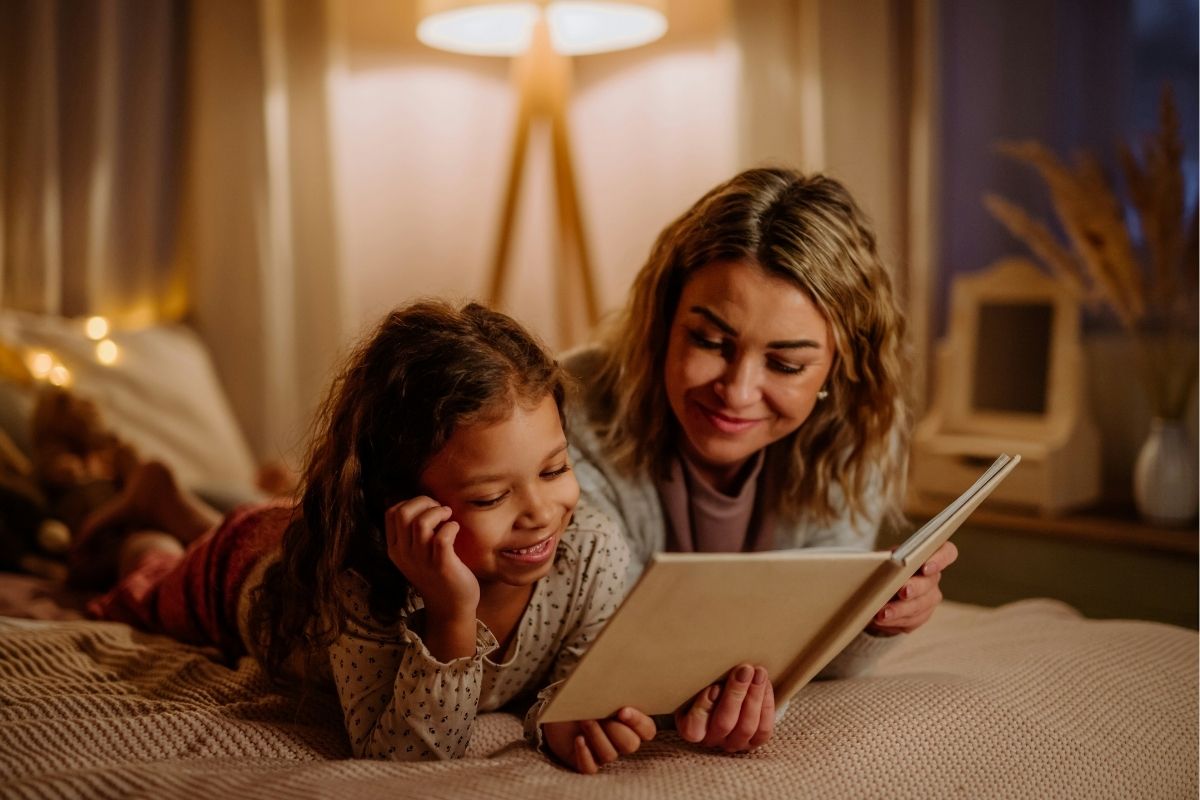



There is a kind of story a child holds onto. It is rarely the most polished one. It is the story you tell in the car on the way home, or at the kitchen table while dinner is half made, or in the last few minutes before sleep when the day finally slows down. Sometimes it comes from a library book. Sometimes it is a memory a mother reaches for without planning to. Other times it is the same story a child asks for again and again, long after the parent is tired of telling it.
Most mothers know stories matter. It is easy, though, to file storytelling under reading, or bedtime, or literacy, or a tradition you hope to keep. Storytelling is all of those. It is also one of the first ways a child learns what feelings mean, where they come from, and how to hold them.
That is what intergenerational storytelling really is: emotional meaning passed from one generation to the next through story, in whatever form the story takes. What a child inherits is not always a grand family legend. Often it is something simpler and more lasting: the sense that a feeling can be met, stayed with, and survived.
What is intergenerational storytelling?
Most people hear the word and picture a grandparent passing something down to a grandchild. That is part of it. But look at the word itself: inter means between. Intergenerational storytelling is not only what travels in one direction, from old to young. It is what moves in the space between generations, through story.
That makes it broader than it first sounds. It includes the grandmother’s memory, and it reaches past it, to the picture book you read with attention to feeling, the story the two of you make up on a slow afternoon, the seasonal one you return to year after year. Any of these can carry emotional meaning between you and your child.
And what it carries is more than information. What a family passes through story is not only what happened, but how it made meaning from what happened. That is the part a child absorbs, the way a feeling gets held, more than the events themselves.
Why storytelling shapes a child’s emotional growth
Children do not absorb emotional safety primarily through instruction. They absorb it by being near an adult who can stay steady close to a feeling, again and again. Storytelling and emotional development are tied together for exactly this reason. A story gives a child distance from a strong emotion without asking them to perform it, room to feel something without being put on the spot.
Inside a story, fear and grief and longing and courage and repair can all be met safely, because they belong to a character first. A child can watch a feeling happen to someone else, recognize it, and try it on, without becoming the subject of a lesson.
You cannot teach a child emotional safety the way you teach a math fact. You build it through repeated experiences of being held, heard, and accompanied. Story is one of the oldest ways families have done that.
How does storytelling support a child’s emotional development?
Storytelling supports emotional development by helping children recognize feelings, make meaning from experience, build empathy, and feel connected to the people around them and before them.
Story lets children name feelings without being interrogated. A child may go silent when you ask, “How do you feel?” The question can feel like a spotlight. But that same child will often respond to a character, a picture, or a moment in a story. The feeling has somewhere to land that is not directly about them, and that small distance is what makes it safe to look at.
Story shows children that feelings move. A story has a beginning, a middle, and an end. Something is hard, and then something shifts. A child who lives inside that shape again and again begins to understand that a feeling is not a permanent place. It can rise, change, soften, and pass. For a young child in the middle of a hard feeling, that is not obvious. Story teaches it without a single explanation.
Story helps children feel less alone. When a child hears that someone else has felt scared, or jealous, or left out, or brave, something in them settles. The feeling stops being a private flaw and becomes part of being a person. Family stories carry this especially well, because the message underneath is that the people I belong to have felt this too.
Story builds identity and belonging. A child who grows up inside stories starts to feel something simple and grounding. I come from people. I am part of something. And I am not floating alone. That belonging becomes part of the ground they stand on when feelings get big.
What did families pass down through stories?
For most of human history, families passed down far more than facts through story. They passed down values and humor and grief, what they survived and what they celebrated, the sayings they repeated, and the tone a family took toward hard things.. Passing down family stories was how a child learned who they were before anyone sat them down to explain it.
You should not hand every story over exactly as it came. Some ground a child. Some ask too much of one too soon. The work is choosing what helps a child feel steadier, and holding the rest with care until they are older.
Story is already in your home
If that sounds like a talent you are not sure you have, take the pressure off. You do not have to produce a beautiful story from nothing. Story is already in the house with you, in more forms than you would think to count.
A library book counts. A picture book becomes intergenerational storytelling the moment you read it as more than a plot, when you notice out loud what a character feels, or let your child stay on one page because it holds something.
A book you make together counts, even drawn in crayon and stapled crooked and never finished.
An invented story counts, but you don’t have to invent one. Some parents love making things up on the spot. Some never will, and that is fine. Invention is one door, not the front door.
Family history counts, if you have it. A grandparent, a childhood mistake you survived, a holiday, a recipe: any of it can carry meaning to a child.
A story-led ritual counts too, especially when you want the framework and do not have the lore or the bandwidth to build it yourself.
The move is not producing the perfect story. It is bringing attention to feeling inside whatever story is already happening.
A note from me
I do not come from a family with a trove of stories to pass down, the way some people do. That is part of why I care so much about the forms of storytelling that do not depend on a perfect inheritance. The power of story does not belong only to families who kept careful records of it. It belongs to any parent willing to slow down inside a story and let a feeling be seen.
You don’t need a family full of storytellers
You do not need a family full of storytellers. Nor do you need to invent something clever on the spot or a flawless family history. You need a way in.
I created the River & Ember Method partly because I needed one myself. It is the framework I built to put story to work on purpose, and it starts from a single question: what does this feeling need right now? Story, ritual, reflection, and art are how it answers that question with a child, a little at a time, until the practice becomes a rhythm instead of one more thing to invent.
The Seasonal Edition is how I bring it home for other families. It gathers the stories, the rituals, and the reflection and art into one season at a time, made for the parent who wants the way in without building it from scratch. Not inherited lore, not a gift for making things up. Just a way to bring story and feeling together, already held for you.
A simple family storytelling ritual to try this week
If you want to begin before anything else, you can do it this week with what you already have.
Choose one story. Any form counts. A library book, a family memory, a story you make together, a seasonal one, or one you already return to. Pick one that carries a feeling.
Tell it simply. No performance. No perfect wording. And no lesson you are trying to force in at the end.
Ask one reflection question. Keep it light and open. What part of that story stayed with you? What do you think that person felt? Have you ever felt something like that? What do you think changed by the end?
Make something. Invite your child to draw, paint, shape, or write one image from the story. The art does not need to explain the feeling. It gives the feeling somewhere to go.
That is the whole practice. A story, a question, something made. Small enough to do again next week.
Why is storytelling important in early childhood?
Storytelling is important in early childhood because young children meet the world first through image, rhythm, repetition, tone, and relationship. Before a child can explain a feeling, they can often recognize it in a character, hear it in a parent’s voice, or return to it through a story they ask for on a loop.
This is easiest to see in the early years, but it does not end there. A four-year-old may point at the picture. A seven-year-old may draw the feeling. A nine-year-old may ask whether it really happened. An eleven-year-old may act like they are not listening and then bring the story back three days later. Story can support language and listening and imagination along the way. The deeper work, the reason it lasts, is emotional. It gives a child a way to meet a feeling without being put on the spot, for years longer than you might expect.
Frequently asked questions about intergenerational storytelling and emotional development
What is intergenerational storytelling?
Intergenerational storytelling is the passing of emotional meaning from one generation to the next through story. It can include family memories and grandparent stories, and it can also happen through a picture book, a made-up story, a seasonal ritual, or any story a parent uses to help a child meet a feeling.
How does storytelling help a child’s emotional development?
Storytelling and emotional development are closely linked. Stories help children recognize feelings, build empathy, make meaning from experience, and feel less alone with what they feel, all without asking the child to explain the feeling directly.
What is emotional storytelling?
Emotional storytelling is storytelling that helps a child notice, feel, and make meaning from emotion. It is not about making a story dramatic. It is about letting a feeling have shape, language, and somewhere safe to go.
Why is storytelling important in early childhood?
Young children often understand feeling through image, repetition, rhythm, tone, and relationship before they can explain it in words. Story gives them a safe way to meet emotions through characters, pictures, and repeated moments of connection with a trusted adult.
Does reading picture books count as intergenerational storytelling?
Yes. A picture book becomes intergenerational storytelling when a parent reads it as more than a plot. When you notice what a character feels, wonder with your child, or return to a story because it holds something, you are passing down a way of meeting emotion through story.
What if I don’t have family stories to pass down?
You do not need a perfect family history or a trove of inherited stories. Intergenerational storytelling can begin with the story in front of you, whether that is a library book, a story you make together, a seasonal one, or a simple ritual that helps you and your child bring feeling into words, images, and connection.
Is intergenerational storytelling only about grandparents?
No. Grandparents and elders can be part of it, but the heart of intergenerational storytelling is meaning moving from one generation to the next. A mother can pass that meaning to her child through a book, a ritual, a memory, or the way she helps a child stay with a feeling.
Begin with one story
Your child does not need every story to be polished. Your family history does not need to be complete. You do not need to become a different kind of mother than the one you already are. What a child needs is repeated moments where a feeling has somewhere to go, and connection they can return to.
So begin with one story. Return to it. Let it become a rhythm.
And if you would like the stories, rituals, reflection, and art already gathered for you, the Seasonal Edition holds exactly that, a story-led family ritual practice for mothers and children ages four to twelve. It grows from the same belief that runs through the children’s book I am writing: that children meet feeling most naturally through story, long before they are asked to explain it.



+ show Comments
- Hide Comments
add a comment